
Origins of Common Pleas Courts
The Court of Common Pleas traces its lineage to medieval England, where it emerged as an offshoot of the ancient Curia Regis (the King's Court) established by William the Conqueror. During the latter years of the 12th century, the English Crown created a separate Court of Common Pleas consisting of one chief justice and four associate justices. Its jurisdiction was confined to civil matters, having no authority over criminal cases, which remained under the purview of pleas of the crown.
When English colonists settled in America, they brought with them the common law tradition, including the Court of Common Pleas system. This judicial framework would later influence the development of American courts after independence.
Common Pleas Courts in the Northwest Territory
The court of common pleas was the first civil court established under the Ordinance of 1787 in the Northwest Territory. When the Governor and judges of the Northwest Territory confronted the task of establishing civil courts in Washington County, Ohio in 1788, they looked to the established pattern of England's court system and its prototypes in the states of the new Union.
The law established that "a number of suitable persons, not exceeding five, nor less than three shall be appointed in each county, and commissioned by the Governor under the seal of the Territory to hold and keep a court of record, to be styled the County Court of Common Pleas." The jurisdiction covered "all manner of pleas, actions, suits and causes of a civil nature, real, personal and mixed according to the constitution and laws of the territory."
An interesting historical note: the first five judges appointed by the legislature in the Northwest Territory—Rufus Putnam, Benjamin Tupper, Archibald Crary, Isaac Pierce, and Thomas Lord—had no legal training whatsoever. They were each commissioned as justices of the peace and therefore qualified to sit in hearing cases. This reflected the practical realities of frontier justice in early Ohio.
Notably, William Henry Harrison, who would become the ninth President of the United States, served as a Clerk of the Court of Common Pleas early in his career.
Common Pleas Courts Under Ohio's Constitutions
The Constitution of 1851
Ohio's Constitution of 1851 firmly established the Court of Common Pleas as a constitutional court. Article IV, Section 1 of the Constitution created the court, making it the only trial court created by the Ohio Constitution itself. The duties of these courts were outlined in Article IV, Section 4.
The 1851 Constitution also provided that probate courts were to be established as separate independent courts with jurisdiction over the probate of wills and supervision of the administration of estates and guardianships.
The Modern Courts Amendment of 1968
A significant transformation occurred in 1968 when Ohio voters adopted the Modern Courts Amendment to the Ohio Constitution. This amendment restructured the judicial system by abolishing separate probate courts and instead establishing probate divisions of the courts of common pleas. This consolidation reflected a modernization of Ohio's judicial structure while maintaining the constitutional foundation of the Common Pleas Court system.
Structure and Jurisdiction of Ohio Common Pleas Courts Today
Today, there is a Court of Common Pleas in each of Ohio's 88 counties. These courts serve as the trial courts of general jurisdiction in the state and remain the only trial courts created by the Ohio Constitution.
The Ohio General Assembly has divided courts of common pleas into four main divisions:
General Division
The General Division has original jurisdiction in all criminal felony cases and all civil cases in which the amount in controversy exceeds $15,000. General divisions also handle all cases involving title to real estate (except eviction matters) and have appellate jurisdiction over the decisions of some state administrative agencies and city agencies.
Some Ohio Courts of Common Pleas have established specialized business court tracks, called Commercial Dockets, including those in Cuyahoga County, Hamilton County, and Lucas County.
Domestic Relations Division
This division has jurisdiction over proceedings involving divorce, dissolution of marriage, annulment, legal separation, spousal support, domestic and dating violence civil protection orders, and matters concerning parental rights, children, and allocation of parental rights and responsibilities.
Juvenile Division
Juvenile divisions hear cases involving juvenile delinquency (minors under 18 years of age charged with acts that would be crimes if committed by an adult) as well as cases involving unruly, dependent, and neglected children. Juvenile courts also have jurisdiction in adult cases involving paternity, child abuse, non-payment of child support, contributing to the delinquency of minors, and the failure to send children to school (truancy).
Probate Division
Probate divisions handle wills, estate matters, and guardianships. They also have jurisdiction over the issuance of marriage licenses, adoption proceedings, determination of sanity or mental competency, name changes, and certain eminent domain proceedings. Probate judges may also solemnize marriages within their counties and charge a fee for the service.
Judicial Selection and Terms
Judges of the Court of Common Pleas are elected to six-year terms on a nonpartisan ballot, although candidates may choose to run in partisan primary elections. To be appointed or elected to the court, a person must be an attorney with at least six years of experience in the practice of law and must be a resident of the district or county they serve.
Chief judges of Ohio Courts of Common Pleas are chosen by peer vote and serve for one-year terms.
Wayne County Court of Common Pleas: A Historical Overview
Formation of Wayne County
Wayne County, Ohio, as it exists today was described in legislation in 1808 but was not formally organized until January 1812, with effect from March 1. The county was named in honor of General "Mad" Anthony Wayne, the Revolutionary War hero and military commander.
Wayne County was organized under an Act of the Legislature of the State of Ohio bearing date January 4, 1812, to take effect on the first day of March 1812. The Act provided "that the county of Wayne be and the same is hereby organized into a separate county." The same law provided that the people of the county should elect county officers on the first Monday of April 1812, to hold their offices until the next annual election.
The county seat was established at Wooster, which remains the center of judicial activity for Wayne County to this day.
Early Circuit Court System
Prior to the Constitution of 1851, Ohio had a system of District and Circuit Courts, and judges literally rode "the circuit" on horseback or by buggy. The Term of Court began only when the Circuit Judge arrived at the County Seat, and the judge stayed as long as there were cases to be heard. This system of circuit riders was common throughout frontier America and reflected the practical challenges of administering justice across vast, sparsely populated territories.
The First Judge: Benjamin Ruggles (1812)
Benjamin Ruggles holds the distinction of being the first Common Pleas Judge in Wayne County, Ohio, serving from 1812. Ruggles was a New Englander attracted to Ohio to practice law. He practiced law in Marietta until he received a judicial appointment that started him on his way to eventually serving in the United States Senate.
Judges of Wayne County Court of Common Pleas
While comprehensive records of all judges who have served are maintained in historical archives (including a roster covering 1814-1941 referenced in historical documents), the following judges are documented in available sources:
Historical Judges:
- Benjamin Ruggles (1812) - First Common Pleas Judge in Wayne County
Current Judges (as of 2025):
Judge Corey E. Spitler - First elected in 2010 to the Common Pleas Court and elected for his third and final term in 2022. Judge Spitler is a graduate of Dickinson College in Carlisle, Pennsylvania. He attended the University of Akron School of Law while working full-time. He served as a bailiff/law clerk for Judge Robert Brown, then as an assistant county prosecutor for six years, and later as the first magistrate for the Wayne County Municipal Court before entering private practice. He also served part-time as a magistrate in the Wayne County Common Pleas Court overseeing the foreclosure docket and the newly established Drug Court.
Judge Timothy R. VanSickle - Elected in 2022 to serve Wayne County as Judge in the Court of Common Pleas, General Division. Judge VanSickle was born and raised in Wayne County, Ohio, and graduated from Triway Local Schools. He received a Bachelor of Science degree in Business Management and a Juris Doctor degree from the University of Akron. He began his legal career as an Assistant Prosecuting Attorney in Montgomery County, then returned to Wayne County and entered private practice. He served as Orrville Law Director, Solicitor for the Villages of Dalton and Doylestown, Magistrate in the Wayne County Juvenile Court, and was appointed to the Wayne County Municipal Court bench in April 2013 before his election to Common Pleas Court.
The Wayne County Courthouse
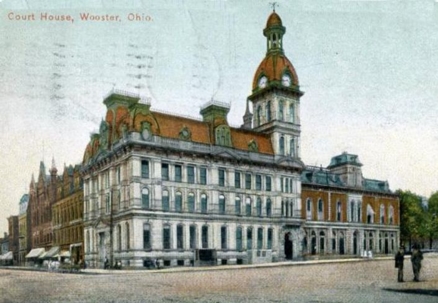
The Wayne County Court of Common Pleas is located on the corner of Liberty and Market streets in downtown Wooster, an area commonly referred to as Public Square. The courthouse has served as the center of justice in Wayne County for generations, housing the General and Domestic Relations Divisions of the Common Pleas Court.
Modern Structure
Today, the Wayne County Common Pleas Court is comprised of the General and Domestic Relations Divisions:
General Division - Has jurisdiction over adult criminal felony cases, civil actions, and oversees the Adult Probation Department.
Domestic Relations Division - Has jurisdiction over cases involving divorce, dissolution, annulments, legal separations, spousal support, and allocation of parental rights and responsibilities.
The Clerk of Courts serves as the official "keeper of the records" and manages and archives all records of the Court of Common Pleas.
Conclusion
The Wayne County Court of Common Pleas represents a continuity of justice that stretches back over two centuries, from frontier circuit riders to modern specialized court divisions. Its evolution mirrors the broader development of Ohio's judicial system—from the rough-hewn frontier courts of the early 19th century to today's sophisticated system of specialized divisions handling complex legal matters.
The court's history reflects not just legal developments but also the growth of Wayne County itself, from a wilderness territory organized in 1812 to a thriving community of over 114,000 residents. Through all these changes, the Court of Common Pleas has remained the constitutional cornerstone of justice in Wayne County, faithful to its mandate under Ohio's Constitution to serve as the trial court of general jurisdiction for the people of the county.
As Wayne County continues to grow and change, its Court of Common Pleas stands ready to meet new challenges while honoring the traditions established by Benjamin Ruggles and the pioneering judges who followed him—a living link between Ohio's frontier past and its future.